
Carpet Fibres & Materials · KARATILE B2B Flooring Knowledge
Carpet Tile Specs Decoded: How Dimensions Shape Your Space
For “Carpet Tile Specs Decoded: How Dimensions Shape Your Space”, do not rely on one material name, number or marketing claim. Translate material names and mark

Direct answer
What decision does this article support?
For “Carpet Tile Specs Decoded: How Dimensions Shape Your Space”, do not rely on one material name, number or marketing claim. Translate material names and marketing language into parameters that can be checked in data sheets, samples and reports. The decision must trace to project conditions, samples and product-specific evidence.
This guide is for designers, quality/EHS teams, procurement working together during comparison, project review or pre-delivery checks. Use it with the actual zones, traffic, schedule, budget and available documents.
Translate material names and marketing language into parameters that can be checked in data sheets, samples and reports.Ready for project review
Key takeaways
- 01
When evaluating “Carpet Tile Specs Decoded: How Dimensions Shape Your Space”, first document the zones, traffic, schedule and maintenance assumptions.
- 02
Products with the same material name can differ through construction, formulation and process control.
- 03
A higher number is not automatically a better fit; context and maintenance matter.
- 04
Every product-level conclusion should trace to the relevant sample and document.
Answer blocks
Turn the core question into actionable answers
What should be checked first for “Carpet Tile Specs Decoded: How Dimensions Shape Your Space”?
Confirm the relevant zones, intensity, schedule, budget and maintenance conditions, then verify each conclusion against physical samples, the exact data sheet and valid evidence.
How should a data sheet be read?
Review yarn/colouration, pile, backing, format, mass information and test methods in layers, tied to the exact product code.
What should sample review include?
Inspect face, backing, edges, thickness, joins, direction and batch, with a small layout mock-up where appropriate.
When specifying carpet tiles, size is a fundamental dimension that often gets overlooked. In China, the ubiquitous 50×50 cm format isn't arbitrary—it reflects decades of architectural practice. Office buildings here use metric modular systems: column spacing, partitions, and furniture all align to this grid. The 50 cm dimension fits seamlessly, maximizing material efficiency and installation speed. This convention has dominated the market for nearly 30 years.
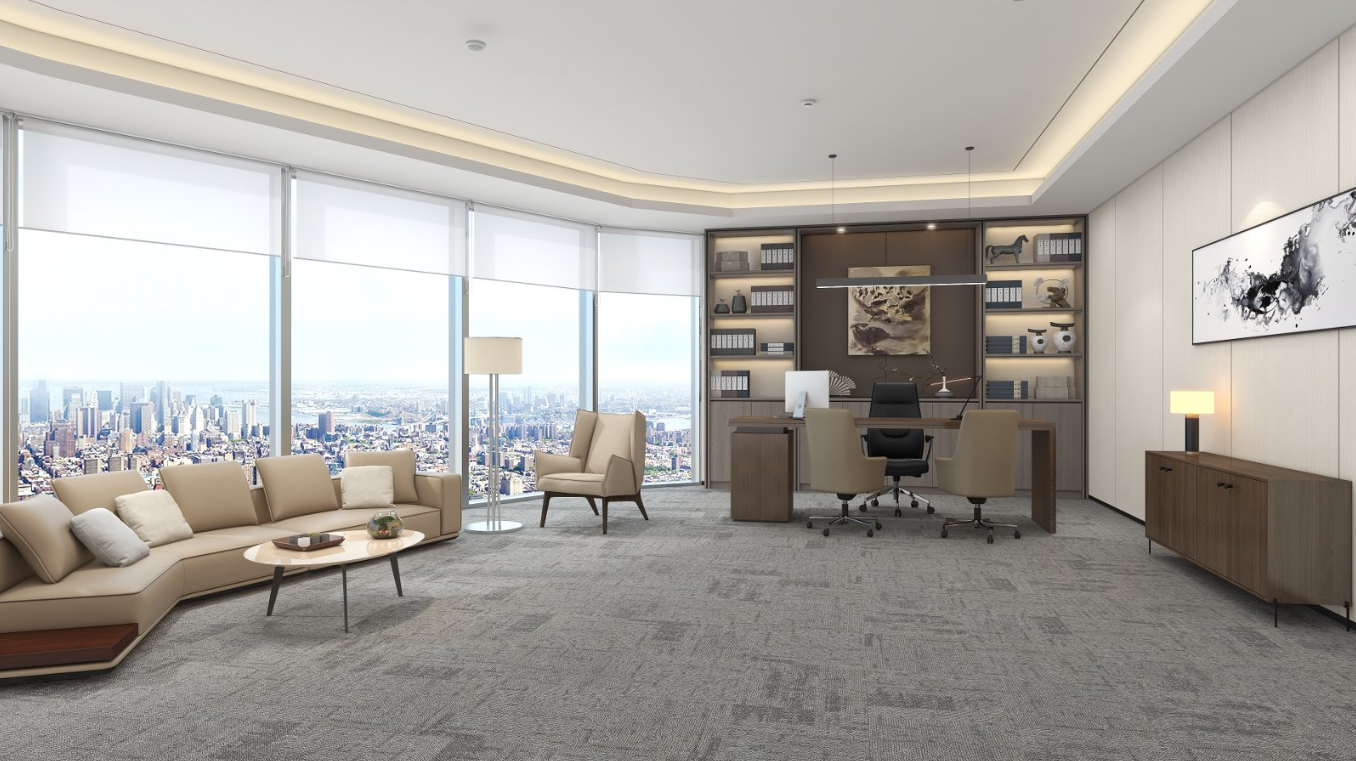
Then there are the "odd" sizes—61×61 cm and 46×91 cm. These trace back to imperial unit conversions: 61 cm equals 24 inches, while 46×91 cm approximates 18×36 inches. Their presence in China stems from the 1990s influx of foreign investment. Multinationals and overseas design firms brought imperial-based drawings, standards, and material specs. To accommodate their design systems, these dimensions were gradually adopted locally.
More recently, plank formats like 25×100 cm have gained traction. This shift reflects evolving design priorities. Long, narrow office carpet tile planks elongate spatial perception, direct visual flow, and enable creative layouts—herringbone, brick bond, gradients—that deliver more expressive interior statements.
At KARATILE, we're focusing on larger formats: 33×100 cm and 50×100 cm. Fewer seams mean cleaner visuals. These sizes preserve the flexibility of modular carpet tile systems while achieving the cohesive look of broadloom carpet. Paired with our lightweight soft backing, a single installer can handle transport and placement, dramatically improving on-site efficiency.
All KARATILE formats feature area-friendly calculations:
50×50 cm: 4 tiles per m²
25×100 cm: 4 planks per m²
33×100 cm: 3 planks per m²
50×100 cm: 2 planks per m²
Designers and procurement teams get quick, accurate quantity takeoffs every time.
How to choose? It depends entirely on spatial requirements:
Square tiles (e.g., 50×50 cm): Cost-effective, easy maintenance, proven reliability
Plank formats (e.g., 25×100 cm): Design-forward, linear flow, ideal for gradients
Oversized formats (e.g., 33×100 cm, 50×100 cm): Seamless aesthetic, commanding presence for large floorplates
KARATILE remains focused on the domestic China market. Every dimension we offer is metric-based, purpose-built for local projects. No size is inherently better—only more appropriate. Understand the logic behind the dimensions, and you'll select the carpet tile that truly fits your space.
For procurement review
Decision comparison
| Layer | Question answered | Procurement evidence |
|---|---|---|
| Yarn/dyeing | Colour, soil response and appearance retention | Material declaration and tests |
| Pile | Comfort, appearance and traffic fit | Construction, pile height and density |
| Backing | Dimensional stability, feel and installation | Backing composition and application notes |
| Finished tile | Safety, durability and environmental profile | Product-specific data sheet and reports |
Claim → Evidence
How claims map to evidence
ClaimOne material is inherently more durable
EvidenceMaterial name is insufficient; use construction, context and product-specific tests
ClaimThe product has a stated environmental profile
EvidenceValid test/declaration for the exact product and version
ClaimThe sample represents delivered goods
EvidenceApproved-sample ID, batch/tolerance agreement and receipt inspection
When product-specific evidence is unavailable, retain the verification method and boundary instead of presenting an assumption as fact.
Process map
From question to delivery
- 01Define useTraffic, castors, cleaning and life
- 02Break down constructionYarn, pile, backing and format
- 03Check evidenceMethod, sample and product scope
- 04Validate in contextMock-up and operating limits
Retain samples, specifications or approval records at every step so decisions survive the handoff from design to procurement and installation.
FAQ
Frequently asked questions
What should be checked first for “Carpet Tile Specs Decoded: How Dimensions Shape Your Space”?
Confirm the relevant zones, intensity, schedule, budget and maintenance conditions, then verify each conclusion against physical samples, the exact data sheet and valid evidence.
Why can products using the same material perform differently?
Yarn grade, twist or coloration, pile construction, density, backing and process control all affect the finished tile.
Is a higher number always better?
No. Specifications must match traffic, maintenance, comfort, budget and site conditions; over-specification wastes cost and mismatch creates failures.
How do I verify a test report applies to my project?
Match the sample name, product code, construction, client, method, date and result to the product being supplied.
Evidence and further reading
Sources
China official / standards
- GB 18586—2026 国家标准信息standard
International research / technical sources
References support standard status, industry methods or design context and do not endorse every third-party claim.
Continue reading
More from this decision path
 Carpet and Indoor Air Quality: Dust Control, Cleaning and Evidence
 Large-Format Soft-Back Carpet Tile: Design Fit and Delivery Considerations
 Large-Format Carpet Tile: Construction, Format and Application Guide
Internal knowledge links
From knowledge to products and applications
Next step
Request the exact data sheet and sample
Share project city, area, zones, schedule, budget and reference images for a response using the same decision model.